

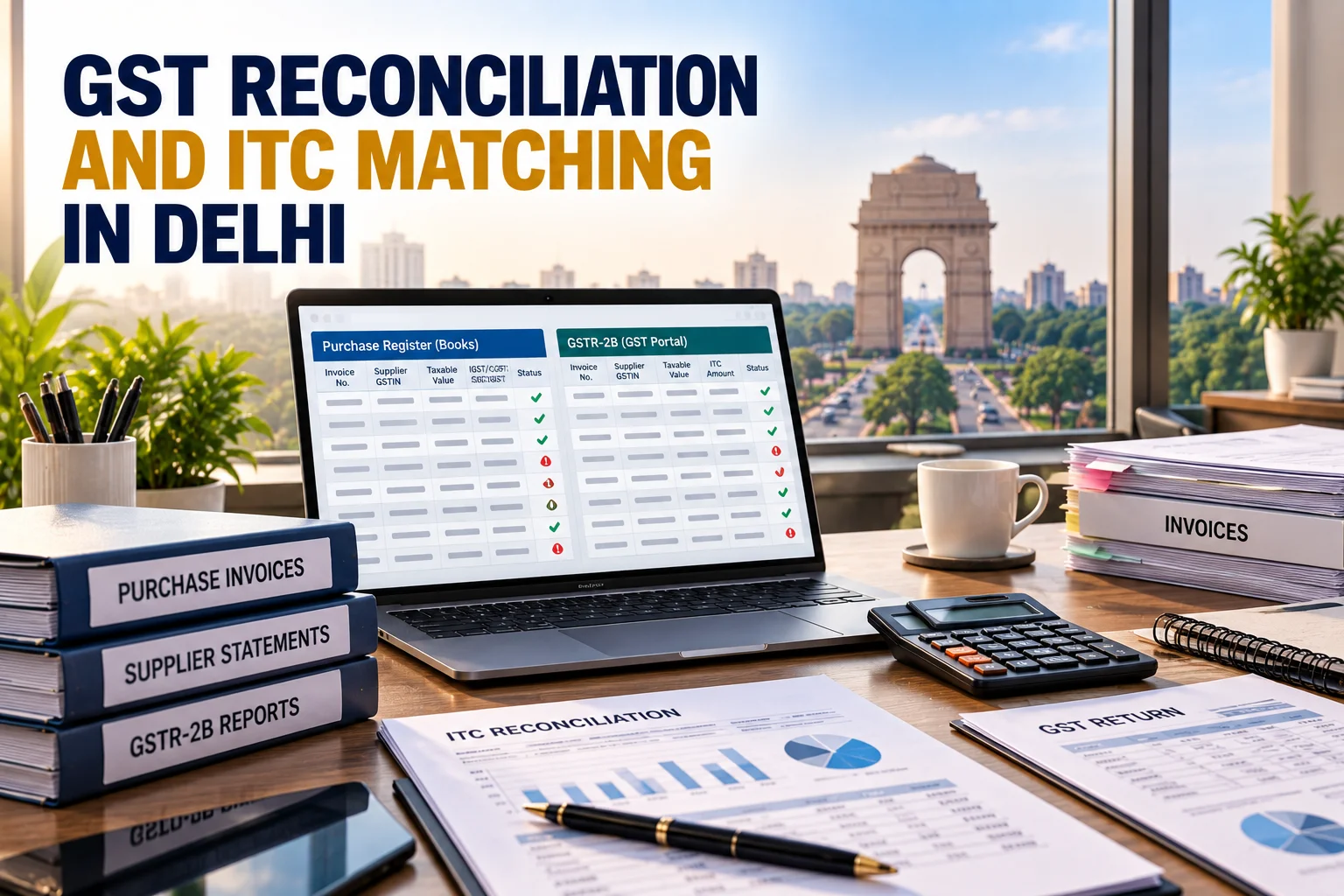
GST Reconciliation and ITC Matching in Delhi
Managing GST correctly requires more than simply filing returns on time. Businesses also need to ensure that purchase records, supplier-reported invoices, and Input Tax Credit (ITC) claims are properly reviewed. GST Reconciliation and ITC Matching in Delhi helps businesses compare their books and purchase records with GST data, identify differences, and take appropriate corrective action before filing or finalising returns.
For businesses operating in Delhi, regular reconciliation can be particularly useful when there are large numbers of purchase invoices, multiple suppliers, credit notes, debit notes, amendments, or transactions recorded across different accounting systems. Form GSTR-2B is an auto-drafted ITC statement based on information furnished by suppliers and other relevant sources, and the GST portal advises taxpayers to reconcile it with their own records and books of accounts.
Taxfello provides professional tax and compliance support to businesses that want to manage GST records more systematically and reduce avoidable reconciliation issues.
Understanding GST Reconciliation and ITC Matching in Delhi
GST Reconciliation and ITC Matching in Delhi involves comparing the purchase records maintained by a business with the GST information available through the GST system.
The objective is to identify differences between the company's books, purchase register, invoices, and relevant GST statements. These differences can occur for several reasons, including delayed supplier filing, incorrect GSTIN, invoice number errors, tax amount differences, amendments, credit notes, or invoices recorded in one period but reported by the supplier in another.
GSTR-2B plays an important role in this process. The GST portal describes GSTR-2B as a static, auto-drafted ITC statement that shows the availability of ITC against documents reported by suppliers and other relevant sources. It is generated for each tax period and can be downloaded from the GST portal.
Reconciliation allows businesses to understand these differences before making an ITC claim and helps create a more reliable GST working process.
Why GST Reconciliation and ITC Matching in Delhi Matters
The amount of ITC involved in regular business purchases can be significant. Even a small mismatch across hundreds of invoices can create a noticeable difference between the purchase register and the GST data.
For example, a Delhi-based business may purchase goods from suppliers located across different states. If one supplier reports an invoice with an incorrect GSTIN or reports it later than expected, the buyer's purchase register may not immediately match the corresponding GST data.
Without regular reconciliation, such differences can remain unnoticed until return preparation or a subsequent review.
The GST portal specifically advises taxpayers to reconcile GSTR-2B with their own records and books of accounts. It also highlights the importance of ensuring that ITC is not claimed twice, required reversals are made, and applicable reverse-charge liabilities are considered.
7 Key Benefits of GST Reconciliation and ITC Matching
1. Helps Identify Invoice Mismatches
One of the primary advantages of GST Reconciliation and ITC Matching in Delhi is the ability to identify differences between purchase records and GST data.
An invoice may exist in the company's books but not appear in the relevant GSTR-2B. Conversely, an invoice may appear in GST data but not have been recorded in the purchase register.
Matching invoice number, invoice date, supplier GSTIN, taxable value, and tax amounts can help businesses identify these differences systematically.
2. Supports More Accurate ITC Review
ITC should not simply be claimed because an invoice appears in a system-generated statement. Businesses still need to assess whether the credit is eligible under the applicable GST provisions.
The GST portal explains that taxpayers should self-assess ITC eligibility and that there can be circumstances where credit is not available even beyond the specific scenarios identified within GSTR-2B.
CBIC's ITC guidance also sets out documentary requirements and conditions associated with claiming input tax credit.
Therefore, reconciliation should be treated as both a matching exercise and an ITC review process.
3. Helps Detect Duplicate ITC Claims
Duplicate credit can occur when the same invoice is accidentally entered more than once in accounting records or processed through different systems.
A structured reconciliation process can compare invoice numbers, supplier GSTINs, dates, taxable values, and tax amounts to identify potential duplicates.
The GST portal specifically advises taxpayers to ensure that no credit is availed twice for the same document.
Regular matching can therefore improve the quality of the purchase register and reduce the possibility of duplicate ITC being considered during return preparation.
4. Helps Track Supplier Reporting Issues
A supplier's filing activity can directly affect the GST data available to a recipient.
For example, an invoice may be correctly recorded in the buyer's books but not appear in the expected GSTR-2B because the supplier has not yet furnished the relevant details or has reported them with an error.
GSTR-2B is generated from information furnished by suppliers and other specified sources. The GST portal also explains that documents filed after the relevant cut-off can appear in a subsequent GSTR-2B.
Reconciliation helps businesses identify these cases so they can follow up with suppliers where necessary.
5. Improves GST Return Preparation
When purchase records have already been reconciled, preparing GST returns becomes more structured.
Instead of reviewing hundreds of invoices while preparing a return, the business can work with a reconciliation report that separates matched invoices from mismatches, missing documents, duplicates, amendments, and other exceptions.
This can help tax professionals and finance teams focus their attention on transactions that actually require review.
6. Creates Better Financial Records
GST reconciliation can also improve the overall quality of accounting records.
When businesses regularly compare purchase registers with GST data, they can identify missing invoices, incorrect tax classifications, duplicate entries, and other accounting inconsistencies.
This creates a stronger connection between bookkeeping and GST compliance.
For growing businesses, maintaining accurate records is particularly important because transaction volumes can increase quickly as the company expands.
7. Helps Prepare for Compliance Reviews
Proper reconciliation creates an organized record of how ITC was reviewed.
If a business needs to explain a mismatch or respond to a GST-related query, having purchase registers, invoices, reconciliation reports, and supporting records can make the review process more manageable.
CBIC guidance has also addressed situations involving differences between ITC claimed and supplier-reported data and identifies conditions that may need to be examined when determining eligibility.
A consistent reconciliation process therefore provides a useful compliance control rather than being merely an accounting exercise.
How the GST Reconciliation Process Works
A typical GST Reconciliation and ITC Matching in Delhi process begins with collecting the relevant purchase register for the period.
The business then obtains the applicable GSTR-2B data from the GST portal. The GST portal allows taxpayers to view and download GSTR-2B, including data in downloadable formats such as Excel and JSON.
The purchase register and GST data can then be matched using fields such as supplier GSTIN, invoice number, invoice date, taxable value, and tax amount.
Invoices that match can be marked as reconciled. Exceptions can then be separated into categories such as missing in GSTR-2B, missing in books, value mismatch, GSTIN mismatch, duplicate invoice, credit note difference, or amendment-related difference.
The final stage involves reviewing the exceptions and determining the appropriate accounting or GST action.
Common ITC Mismatches in GST
Several types of mismatches can occur during reconciliation.
One common issue is an invoice present in the purchase register but missing from GSTR-2B. This may happen because the supplier has not yet reported the document or because the invoice was reported incorrectly.
Another issue is an incorrect recipient GSTIN. If a supplier enters the wrong GSTIN, the invoice may not appear correctly for the intended recipient.
Taxable value and tax amount differences can also occur when the supplier and buyer have recorded different figures.
Credit notes and debit notes create another reconciliation challenge because they can change the net amount of ITC associated with a transaction.
Amended invoices can also require additional review because the original transaction may have been changed after its initial reporting.
GSTR-2B and ITC Matching
GSTR-2B is central to modern ITC reconciliation. It is a read-only, static statement generated from information reported by suppliers and other specified sources. The GST portal states that taxpayers should use GSTR-2B while reviewing ITC and reconcile the statement with their own records.
However, GSTR-2B should not be treated as the only test of ITC eligibility. The GST portal specifically notes that there can be other situations where ITC may not be available and taxpayers should self-assess and reverse or exclude such credit where required.
This makes a proper reconciliation process important. Matching tells you whether records correspond, while eligibility review determines whether the corresponding credit can actually be claimed.
Common GST Reconciliation Mistakes
One common mistake is reconciling only at the end of the financial year. This can create a large backlog and make it difficult to identify the reason for older mismatches.
Another mistake is matching only invoice numbers without checking supplier GSTIN, taxable value, tax amounts, and invoice dates.
Businesses may also overlook credit notes and amendments. These documents can materially change the net ITC position and should be included in the reconciliation process.
Another issue is assuming that every invoice visible in GSTR-2B automatically qualifies for ITC. The GST portal makes clear that taxpayers still need to assess eligibility under applicable provisions.
Finally, businesses should avoid relying entirely on manual spreadsheets when transaction volumes become large. Structured accounting and reconciliation processes can reduce repetitive work and make exception tracking easier.
How Taxfello Can Help
Managing GST Reconciliation and ITC Matching in Delhi can become challenging when a business has numerous suppliers, multiple GST registrations, frequent purchases, and large volumes of invoices.
Taxfello can help businesses organise their GST reconciliation process by reviewing purchase records, comparing relevant GST data, identifying mismatches, and supporting the resolution process.
The focus should be on creating a consistent monthly or periodic workflow rather than waiting until the return filing deadline.
A structured reconciliation process can help finance teams understand their ITC position, identify supplier-related discrepancies, and maintain better GST documentation.
For businesses in Delhi looking for professional GST compliance support, Taxfello can provide assistance tailored to their transaction volume and accounting requirements.
Frequently Asked Questions
What is GST Reconciliation and ITC Matching in Delhi?
GST Reconciliation and ITC Matching in Delhi is the process of comparing a business's purchase records and accounting data with relevant GST information, particularly GSTR-2B, to identify differences and review ITC eligibility. It helps businesses detect missing invoices, duplicates, tax differences, amendments, and other exceptions.
Why is GST Reconciliation and ITC Matching in Delhi important for businesses?
It helps businesses maintain accurate purchase records, identify mismatches, review ITC eligibility, detect duplicate entries, and address supplier reporting issues. The GST portal advises taxpayers to reconcile GSTR-2B with their own records and books of accounts.
What is the difference between GST reconciliation and ITC matching?
GST reconciliation is the broader process of comparing GST-related records and identifying differences. ITC matching specifically focuses on comparing purchase invoices and other eligible documents with GST data to determine whether the corresponding credit is properly reflected and can be considered for claiming, subject to applicable conditions.
What is GSTR-2B used for?
GSTR-2B is an auto-drafted, static ITC statement that provides information about ITC based on data furnished by suppliers and other specified sources. It is intended to help taxpayers review ITC for their GSTR-3B reporting.
Can ITC be claimed simply because an invoice appears in GSTR-2B?
Not necessarily. The appearance of an invoice in GSTR-2B does not replace the taxpayer's responsibility to assess ITC eligibility under the applicable GST provisions. The GST portal specifically advises taxpayers to self-assess and consider other restrictions that may apply.
How often should a business perform GST reconciliation?
Businesses should consider performing reconciliation regularly, commonly on a monthly or periodic basis aligned with their return and accounting cycle. Frequent reconciliation can make it easier to identify supplier errors, missing invoices, and duplicate records while the underlying transactions are still recent.
Can Taxfello help with GST reconciliation in Delhi?
Yes. Taxfello can support businesses with GST reconciliation, purchase-register review, ITC matching, mismatch identification, and related compliance processes. The appropriate scope of work depends on the business's GST registrations, transaction volume, accounting system, and reporting requirements.
Conclusion
Accurate GST records are an important part of effective tax compliance. GST Reconciliation and ITC Matching in Delhi provides businesses with a structured way to compare purchase records with GST data, identify mismatches, review ITC, and address discrepancies before they become more difficult to resolve.
GSTR-2B provides valuable information for ITC reconciliation, but businesses should still independently assess the eligibility of credit under applicable GST provisions.
Regular reconciliation can improve accounting accuracy, support better return preparation, identify supplier reporting issues, and create stronger documentation for compliance reviews.
If your business needs professional support for GST Reconciliation and ITC Matching in Delhi, contact Taxfello to discuss your GST reconciliation and compliance requirements.